Titanium Fiber Felt for Hydrogen Production

Titanium Fiber Felt
December 23, 2025
Category Connection: Titanium Fiber Felt
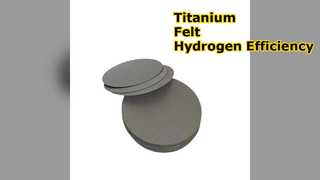
Brief: Watch the demo to catch practical tips and quick performance insights into our High Temperature Sintering Process Titanium Fiber Felt. This video showcases its application in AEM Hydrogen Production, highlighting its gradient pore structure, corrosion resistance, and customizable thickness and porosity for optimal gas flow and efficiency.
Related Product Features:
  • Features a gradient pore structure for efficient gas flow and distribution.
  • Exhibits excellent resistance to medium corrosion for long-lasting durability.
  • Allows precise control over both pore size and porosity for tailored performance.
  • Manufactured from high-purity titanium (Ti≥99.8%) via high-temperature sintering.
  • Offers a large specific surface area to enhance reaction efficiency.
  • Available in thicknesses from 0.15 to 2.0 mm for versatile application.
  • Surface roughness is ≤30 μm, ensuring a smooth and uniform finish.
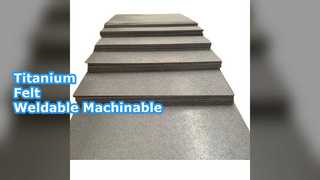
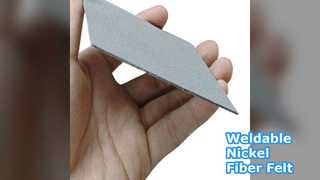
  • Weldable and machinable for easy integration into various industrial systems.
FAQs:
  • What is the primary application of this Titanium Fiber Felt?
    It is primarily designed for AEM Hydrogen Production, where its controlled porosity and corrosion resistance optimize gas diffusion and reaction rates.
  • How is the pore structure of the Titanium Fiber Felt controlled?
    The product features a gradient pore structure, and both the pore size (average 12-20 μm) and porosity (30-50%) can be precisely controlled during manufacturing to suit specific application needs.
  • What are the material specifications and purity of the Titanium Fiber Felt?
    It is made from pure titanium with a chemical composition of Ti≥99.8%, and impurities like N, C, H, Fe, Cl, Si, Mn, and Mg are kept at or below 0.01-0.03% to ensure high performance and corrosion resistance.
  • What are the available dimensions and surface density of this product?
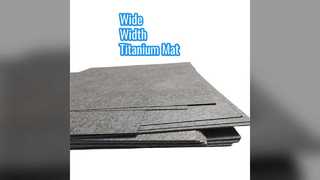
    The Titanium Fiber Felt is available in thicknesses from 0.15 to 2.0 mm, widths from 500 to 1000 mm, and surface densities ranging from 0.6 to 2.0 g/cm³.