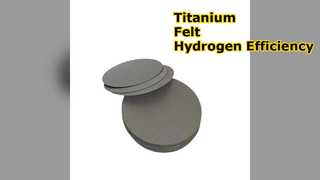
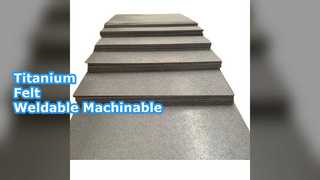
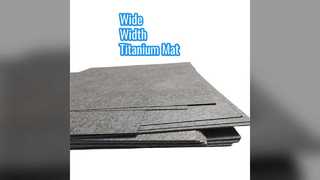
Brief: Watch this overview to discover why many professionals pay attention to this approach. In this video, you will see a detailed walkthrough of Borsemai's 0.15mm-2.0mm Titanium Sintered Plate Porous Gas Diffusion Layer Material, including its manufacturing process, key characteristics, and critical role in PEM hydrogen production applications.
Related Product Features:
Features a controllable pore size and porosity for tailored performance in gas diffusion applications.
Incorporates a gradient pore structure to optimize water and gas transmission efficiency.
Offers excellent electrical and thermal conductivity for efficient energy transfer in electrolysis.
Provides high temperature resistance and thermal shock resistance for durable operation.
Exhibits excellent corrosion resistance in acidic, high-potential environments.
Allows for welding and machining, supporting flexible integration into system designs.
Reduces surface spikes to prevent membrane electrode puncture and extend component lifespan.
Increases contact area with membrane electrodes to minimize electrical contact resistance.
Faqs:
What is the primary application of this titanium sintered plate material?
This material is primarily used as the anode gas diffusion layer (GDL) in PEM hydrogen production systems, where it facilitates mass transfer of O2 and H2O in high-potential acidic environments.
How does the material's structure benefit hydrogen production efficiency?
Its gradient pore structure, controllable porosity, and large specific surface area enable excellent water and gas transmission, reducing concentration polarization and Ohmic polarization during electrolysis.
What are the key advantages for membrane electrode assembly (MEA) lifespan?
The material's low surface roughness and minimized surface spikes help prevent puncturing of the membrane electrode, thereby significantly improving the MEA's operational durability and service life.